Home › Services
Asphalt paving in Houston, built for gumbo clay, flat ground and summer heat
Asphalt paving in Houston is a contest with the ground before it is anything else. The gumbo clay under most of Harris County and Fort Bend County swells after a wet week and shrinks hard in an August drought, and a pavement that ignores that movement starts cracking along its edges within a few seasons. This page walks through how new asphalt and overlays are actually built on the Gulf Coast: digging out, treating the subgrade, setting the base, laying and rolling hot mix, and moving water off nearly level land. It also explains how to read a proposal line by line. If this matches what your property needs, the contact page takes a location and a handful of pictures so a proper scope can be drawn up.
Why Gulf Coast clay decides how long new asphalt lasts
Most of the Houston area sits on fat clay that changes volume with its moisture content. Soak it during a tropical storm and it heaves; bake it through a dry summer and it pulls apart into deep shrinkage cracks. Asphalt is flexible, but it can only bend so far before it splits.
Edges suffer first, because the outer few feet of any pavement lose and gain water faster than the center. Large trees make it worse by drawing moisture out of the clay in a ring around the trunk, and in low spots nearer the bayous a high water table keeps the subgrade soft long after heavy rain. Good asphalt paving here is mostly a plan for controlling moisture and spreading load, with the dark surface layer as the last step rather than the first.
Excavation: digging down to soil worth building on
A new pavement starts with taking things out. The contractor strips anything organic or unstable and looks hard at what is left before a single truck of stone arrives. Material commonly removed includes:
- Topsoil, sod and root mats, which rot and leave voids under the finished surface
- Old asphalt too broken up to serve as a base for anything new
- Gravel that has pumped full of clay fines and lost its strength
- Pockets of saturated soil that squeeze out like toothpaste under a loaded tire
- Buried debris such as old concrete chunks, pipe or construction trash
Stabilizing the subgrade with lime or cement
Once the cut is down to native soil, many Gulf Coast jobs treat that soil rather than simply covering it. Lime stabilization is common on high-plasticity clay: hydrated lime is spread, mixed into the top layer with a reclaimer, watered and allowed to mellow, then remixed and compacted. The reaction reduces the clay's tendency to swell and turns a sticky subgrade into a firmer working platform. Cement treatment is more often used on siltier or sandier soils.
Whether a site needs stabilization, and at what rate and depth, is a judgment the contractor makes for that address, often with a geotechnical report on larger commercial work. A drive on well-drained sandy loam may skip it entirely, while a lot over dark coastal clay may not hold up without it. None of this shows in the finished surface, which is exactly why it is the first thing to ask about.
The aggregate base carries the load, not the asphalt on top
People judge a pavement by the black surface, but the crushed stone underneath does most of the structural work. Flexible pavement spreads a wheel load outward through the base so the clay below sees a gentler, wider pressure. A thin or poorly compacted base concentrates that load, and the subgrade eventually deforms into ruts and depressions.
Around Houston the base is usually crushed limestone, sometimes recycled crushed concrete, placed in lifts and rolled to density with water added to help the particles lock together. The finished base is proof-rolled with a loaded truck to find soft spots before any hot mix is ordered. Its depth depends on soil, traffic and loads, so the contractor sets it for the site; an entrance where garbage trucks turn every week needs a different section than a drive that only sees sedans.
Binder course and surface course: two layers with different jobs
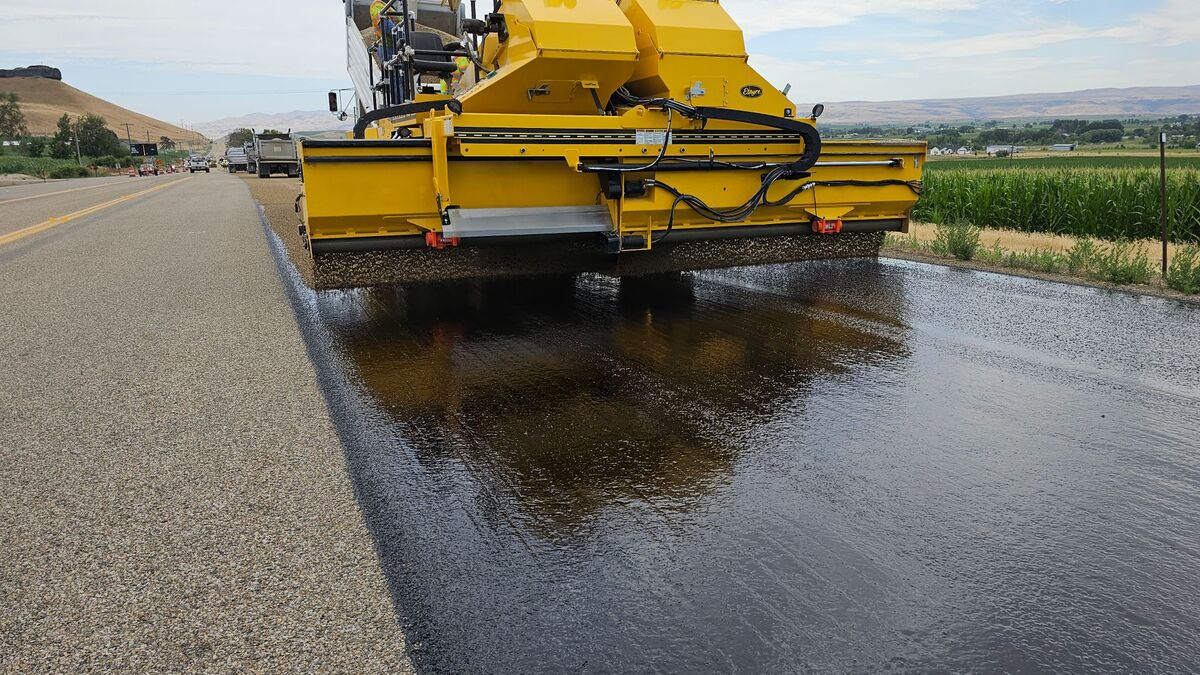
Most commercial asphalt, and many longer residential drives, go down in two distinct layers. A tack coat, a thin sprayed asphalt emulsion, is applied between them so they bond and act as one slab.
- The binder course is a coarser mix with larger stone that adds strength and evens out minor variations in the base.
- The surface course is a finer, denser mix with a tighter texture that sheds water and looks cleaner.
- Single-lift construction is sometimes used for light residential traffic, and the tradeoff should be explained if it is proposed.
- Mix types and lift thickness vary by plant and project, and your contractor specifies them for the traffic the site carries.
Mix temperature and compaction windows in Houston heat
Hot mix leaves the plant very hot and starts cooling the moment it lands in the truck. Compaction has to happen while it is still workable; once it cools too far, the rollers stop gaining density and only polish the surface. A mat rolled too cold stays porous, lets water in and ages quickly.
Summer in Greater Houston stretches that working window, because a warm base and hot air slow the cooling. The catch is that very hot mix can be tender, shoving under the roller if the crew pushes it too early, so good operators adjust rolling timing to the day. A rare cold snap shortens the window sharply, which is one reason asphalt work slows when a winter norther blows through.
Rain is the bigger scheduling problem. Hot mix should not go down on a wet base or in active rain, and summer thunderstorms can stop work with little warning, so many crews start early. A contractor who offers to lay asphalt through a downpour is cutting a corner you will pay for later.
Drainage and cross slope on flat ground
Water is the main enemy of asphalt, and Houston gives it every advantage: almost no natural fall, intense rainfall and clay that holds moisture once it gets in. The pavement has to carry its own slope because the land rarely provides one. A well-designed job addresses:
- A crown or consistent cross slope so the surface sheds water instead of holding it
- Finished grades set against slabs, garage floors and doorways so runoff moves away from buildings
- Swales, ditches or curb lines that carry water to an outlet rather than parking it along the edge
- Inlets placed at true low points and set at an elevation water can actually reach
- Grade checks with a laser during base work, since mistakes are cheap to fix in stone and expensive in asphalt
Edges, curbs and transitions where pavements usually fail
An unsupported asphalt edge has nothing holding it in place, so traffic slowly pushes it outward until it crumbles, a familiar sight on rural roads across the region. Concrete curbs, ribbon curbs or a well-compacted shoulder backfilled against the edge help it hold shape. Where new asphalt meets a concrete apron, a city street or older pavement, a clean saw-cut joint with tack on the vertical face keeps the seam tight; feathered joints break apart quickly and let water in.
Milling and overlay versus full-depth reconstruction
Not every worn pavement needs to be torn out. If the base is sound and the damage is mostly oxidation, raveling or scattered cracking, a mill and overlay can add many years of service. A milling machine grinds off the top layer so the new surface keeps its elevation at curbs, gutters and door thresholds, then tack and fresh hot mix go down. Milled material usually goes back to the plant for recycling.
An overlay cannot fix a failing foundation. When cracking forms the interlocking pattern of base failure, or ruts and depressions run across large areas, new asphalt laid on top will mirror the old cracks within a short time. That is reflective cracking, and full-depth reconstruction is then the honest answer. Diagnosing which distress you have is covered on the asphalt repair page.
Residential and commercial asphalt are different jobs
Most driveways inside city subdivisions around Houston are concrete, poured by the homebuilder. Asphalt makes the most sense on long acreage drives, private lanes, rural roads, gravel conversions and homes replacing an existing asphalt drive, all covered on the asphalt driveways page. Most regional volume is commercial, and that planning lives on the parking lot paving page. To see how the work changes from suburb to suburb, browse the communities served.
How a typical new asphalt job runs from first visit to open traffic
Schedules vary with size, weather and plant availability, but the sequence on a well-run job stays consistent:
- Site visit to measure and check drainage, soil, existing pavement and truck access.
- A written proposal describing the section, scope and options.
- Underground utility locates through Texas 811 before any digging.
- Excavation, removal of unsuitable material and subgrade grading.
- Stabilization where the design calls for it, then compaction.
- Aggregate base placed in lifts, compacted and proof-rolled.
- Tack coat and binder course where specified.
- Surface course laid and rolled inside its compaction window.
- Edge backfill, cleanup and keeping traffic off until the mat firms up.
What a complete asphalt paving proposal spells out
Two bids for the same job can look far apart because they describe different pavements. Your contractor prices the work after seeing it, and the main cost drivers are area, excavation depth, stabilization, the base section, the number and thickness of lifts, drainage work, truck access, haul distance and disposal. Look for these items in writing:
- The paved area and a sketch or description of its limits
- Excavation depth and how unsuitable soil found during the dig is handled
- Subgrade treatment, if any, and how its need was determined
- Base material and compacted section
- Asphalt mix types, number of lifts and compacted thickness of each
- Slope, swales, inlets or curb work included
- Exclusions such as utility relocation, permit fees or landscape repair
- Who obtains any permits the city or county requires
- The workmanship coverage offered and what it applies to
Asphalt paving in Houston — common questions
When is fresh asphalt ready for cars during a Houston summer?
Fresh hot mix hardens as it cools, and in a Houston summer the surface stays soft longer than people expect because the sun keeps reheating it. Cars can usually use a new residential surface once it has cooled and firmed, but sharp turns of the wheel, trailer jacks and kickstands can leave marks for weeks. Heavy trucks should wait longer. The contractor gives a specific reopening time based on the mix, thickness and weather that day.
Can new asphalt be laid right over my old cracked asphalt?
Sometimes. If the old pavement is structurally sound and the cracking is limited to the surface, a prepared overlay with crack repair and a tack coat can work well. If the existing asphalt shows widespread interlocking cracks, ruts or soft spots, the base underneath is failing and new asphalt will crack in the same pattern. A contractor should walk the site and probe questionable areas before recommending an overlay.
Why does asphalt crack so fast on Houston clay soil?
The clay under much of the region expands when wet and contracts as it dries, so the ground beneath a pavement keeps moving. Edges dry faster than the middle, trees pull water from one side, and poor drainage leaves some areas soaked while others bake. Asphalt flexes, but not that much forever. Subgrade preparation, an adequate base, positive drainage and supported edges are what reduce early cracking.
Is lime stabilization really necessary under a new asphalt surface?
It depends on the soil at your address. On dark, sticky clay with high swell potential, mixing lime into the top of the subgrade is a common way to reduce movement and give the base a firmer platform. On sandier soils it may add little, and cement treatment or a deeper base may make more sense. The call should come from what turns up during excavation or from a soils report on larger jobs.
What time of year is best for asphalt paving around Houston?
Hard freezes are rare here, so asphalt goes down most of the year. Late spring and fall tend to be the easiest windows, with fewer afternoon storms than midsummer and steadier temperatures than winter. Summer work is common and the heat helps compaction, but storms interrupt schedules, and winter jobs may pause during cold fronts. Booking ahead of busy stretches lets the contractor schedule around weather instead of rushing.
How do I know if my asphalt needs an overlay or a full rebuild?
Look at the damage pattern. Scattered surface cracks, faded rough texture or minor raveling usually point toward an overlay or targeted repairs. Cracks that link into small scale-like blocks, ruts in wheel paths, sunken areas that hold water and spots that flex underfoot suggest the base has failed, which an overlay will not fix. A contractor can confirm by cutting a small test hole to see the actual layers.
Do I need a permit to pave or repave in Harris County or Fort Bend County?
It depends on the jurisdiction and the scope. Resurfacing an existing area on the same footprint is often treated differently from creating new pavement, changing drainage or connecting a driveway to a public street. Cities, counties and some drainage or utility districts each set their own rules, and commercial work frequently needs plan review. The proposal should state who is responsible for obtaining any approvals at your address.
Talk through your site
Start with the address, what you want done, and a few photographs of the area, including anywhere water sits after a heavy rain.
Related work
Parking Lot Paving
Lots for retail centers, offices, churches, warehouses and apartments, phased to keep a business open.
Parking Lot Striping
Layout, restriping, stalls, arrows, fire lanes and accessible spaces, laid out to the governing standards.
Asphalt Repair
Potholes, alligator cracking, base failure, edge breaks and the repair-versus-overlay decision.
Sealcoating
Crack sealing and sealcoat that slow sun oxidation and water damage, and when sealing is wasted money.
Asphalt Driveways
Asphalt for long, rural and acreage driveways, and how it compares with the concrete common in the city.
Across the metro
Katy
West-side growth along I-10 with master-planned communities, flat prairie clay and slow drainage.
Pearland
South-side suburb with commercial strips, newer subdivisions and heavy-rain drainage concerns.
Sugar Land
Fort Bend County city with office parks, retail centers, HOA communities and expansive clay.
Cypress
Northwest growth corridor with acreage lots, long driveways and new commercial pads.